
Trees of the year 2026
Text and photographs Richard Boon
The Trees of the Year for 2026 are:
Red Ivory
Phyllogeiton zeyheri (formerly Berchemia zeyheri)
Afrikaans rooi-ivoor, Zulu umncaka, umnini or umniyi
The genus Berchemia belongs to the plant family Rhamnaceae, which includes the well-known Ziziphus mucronata (Buffalo Thorn). Members of Berchemia occur in Africa, Asia and the Americas and until recently there were considered to be 20–32 species, depending on the authority consulted.
However, African members differ from their relatives in several ways: they are trees (vs shrubs or climbers), they have opposite or sub-opposite leaves (vs alternate), and they have reddish or yellowish fruit (vs red or dark blue).
Genetic studies published in 2021 by Chinese researchers included two of the African species and showed that the African and Madagascan plants form a group distinct from the rest of Berchemia. Given these genetic and morphological differences, the authors proposed reinstating the genus name Phyllogeiton (originally applied to Brown Ivory) be reinstated for the African/Madagascan species known at the time. A third species, the threatened Phyllogeiton trachybasis (Sand Ivory), was described from Maputaland in 2023.
The Red Ivory is a small, evergreen or deciduous tree, often with a short trunk and rounded canopy and it reaches about 10 m in height. It occurs in bushveld and occasionally in dry forest from southern KwaZulu-Natal to Botswana, Zimbabwe and Mozambique. David Styles says that he only found one specimen in the Krantzkloof Nature Reserve in his many searches for interesting plants.
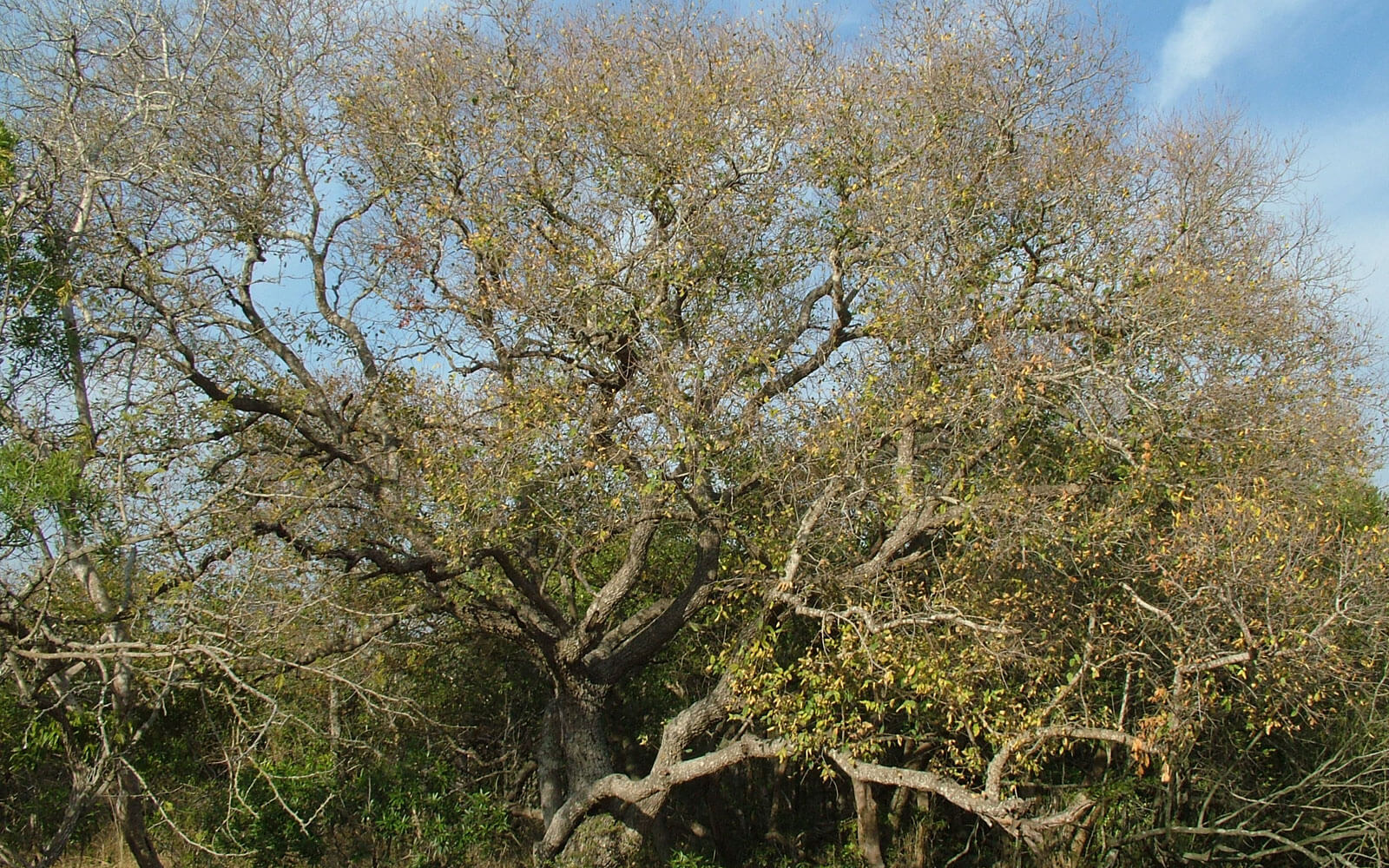
Red Ivory on the Lubombo Mountains losing its leaves in mid-June.
Mature trees are relatively easy to recognise. The bark is rough and forms rectangular blocks. Leaves are arranged in opposite or sub-opposite pairs; they are usually small, thin, hairless and dark green with a slight blue-grey tinge. The veins run to the margin in a distinct herringbone pattern, which is especially clear when viewed from below. The narrowly egg-shaped fruits ripen from orange to red and finally dark red.
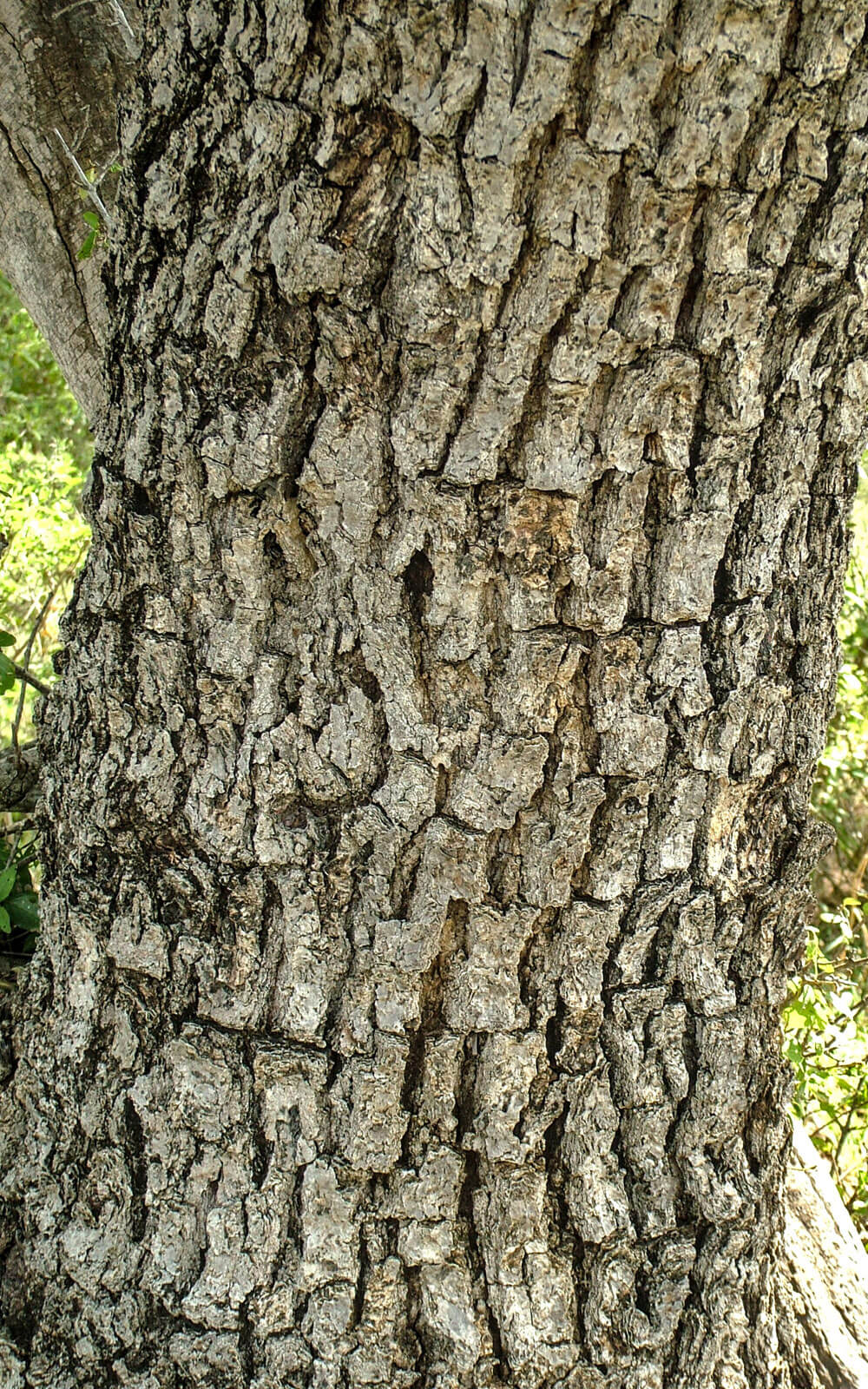
The bark on Red Ivory trees is rough and forms distinctive blocks.
The small green to yellowish green, star-shaped flowers with cream stamens appear in spring and early summer and are highly attractive to insects, especially bees.
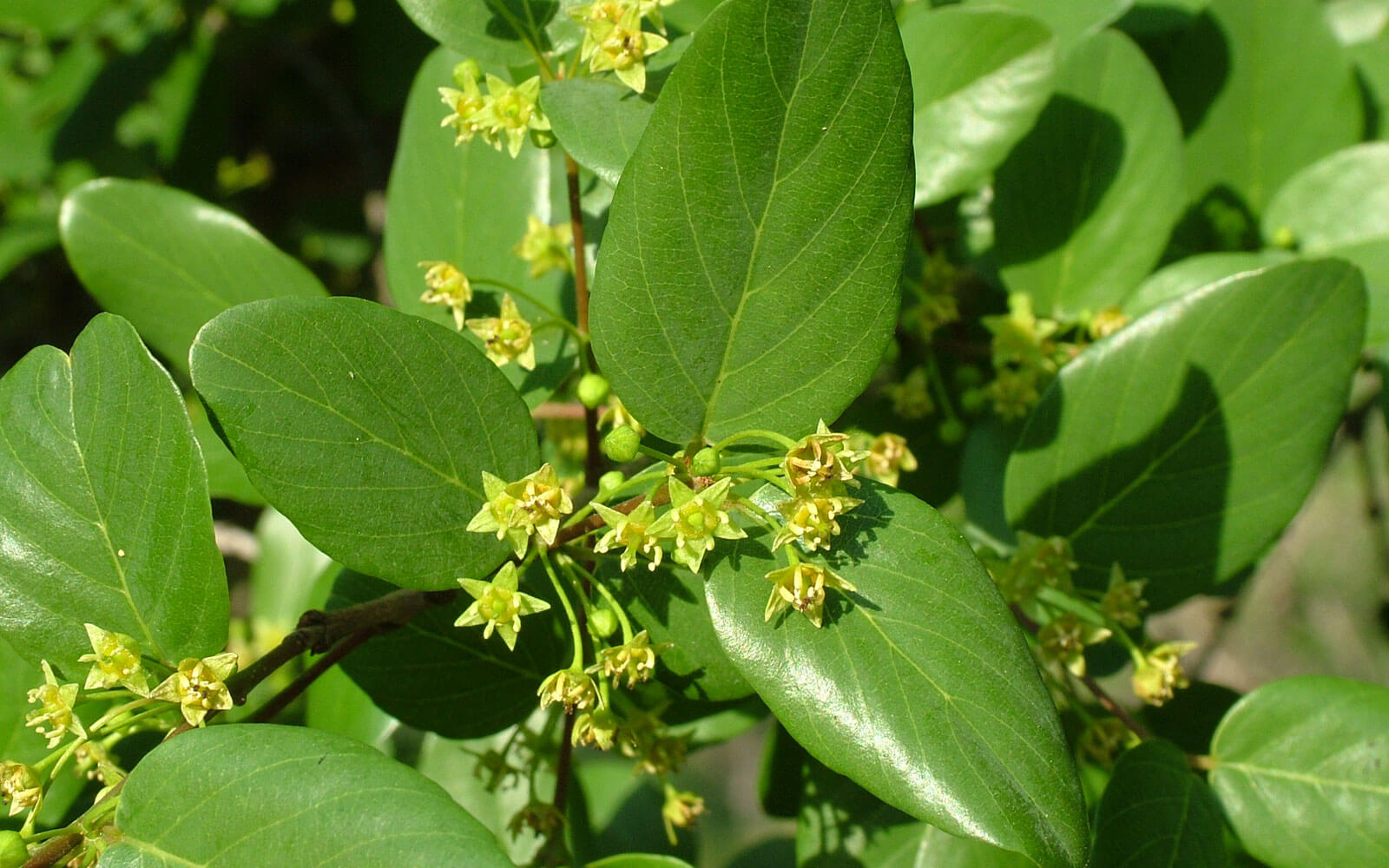
Flowers are small, star-shaped and yellowish green.
The fruit is edible, sweet and eaten by birds, mammals and people. Semi-dried fruit forms a sticky mass that may be sold and eaten as a sweetmeat. Mammals browse the leaves and porcupines may gnaw at the bark at the base of trees.
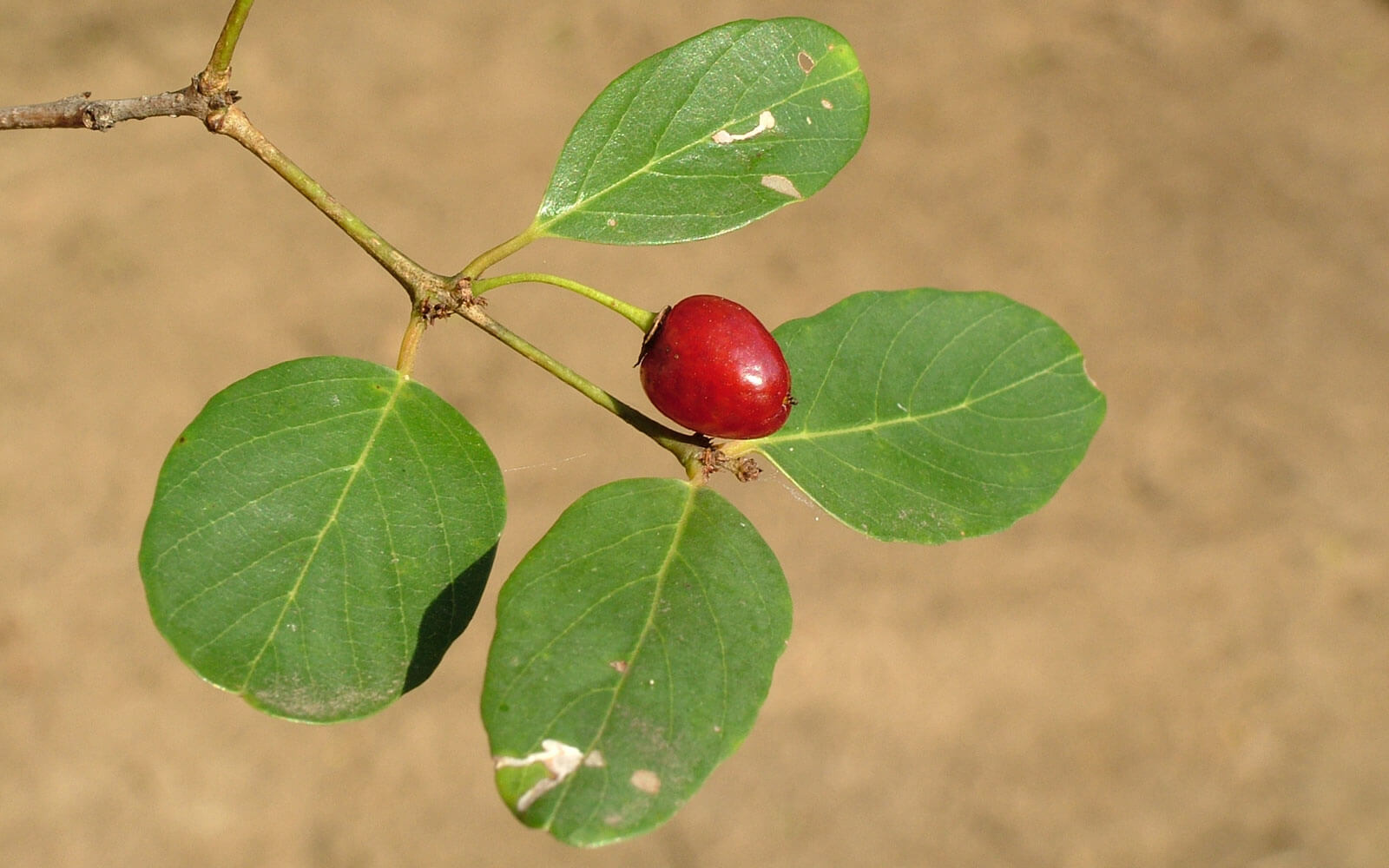
The fruit is red to dark red when ripe and edible and sweet.
Red Ivory is valued for its timber. The heartwood is pink to red, hard, heavy and fine-grained, while the sapwood is yellowish. It is used to make a range of items including furniture, sticks and ornaments. It is also used to make a dye.
Plants parts are used in traditional medicine to treat stomach disorders and backache, and to ward off evil spirits.
The species is easily grown from cleaned seed and is drought resistant but sensitive to frost.
Phyllogeiton zeyheri is named after the German botanist Carl Zeyher, an early plant collector in South Africa whose specimens formed the basis of Flora Capensis.
The genus name Phyllogeiton comes from Greek and means “leaf neighbour”, likely referring to the paired leaves, in contrast to the alternate leaves of Berchemia. Other explanations exist, but they are less convincing.
Berchemia commemorates the 17th-century French botanist M. Berchem.
Wild or African Olive
Olea europaea subsp. africana
Afrikaans olienhout, Zulu umnqumo or umnquma
This is the South and East African subspecies of the cultivated Mediterranean olive—hence the name subspecies africana. “Olea” is the classical Latin word for olive. There are seven recognised subspecies, and together their range stretches from the Cape to the Mediterranean, west to Spain, Portugal and Morocco, and east to south-central China.
Like Red Ivory, the Wild Olive is a small to medium-sized tree, most often found in bushveld or on forest margins. From a distance, trees appear grey-green. The trunk is distinctive: short, twisted, convoluted and gnarled, with fairly rough bark.
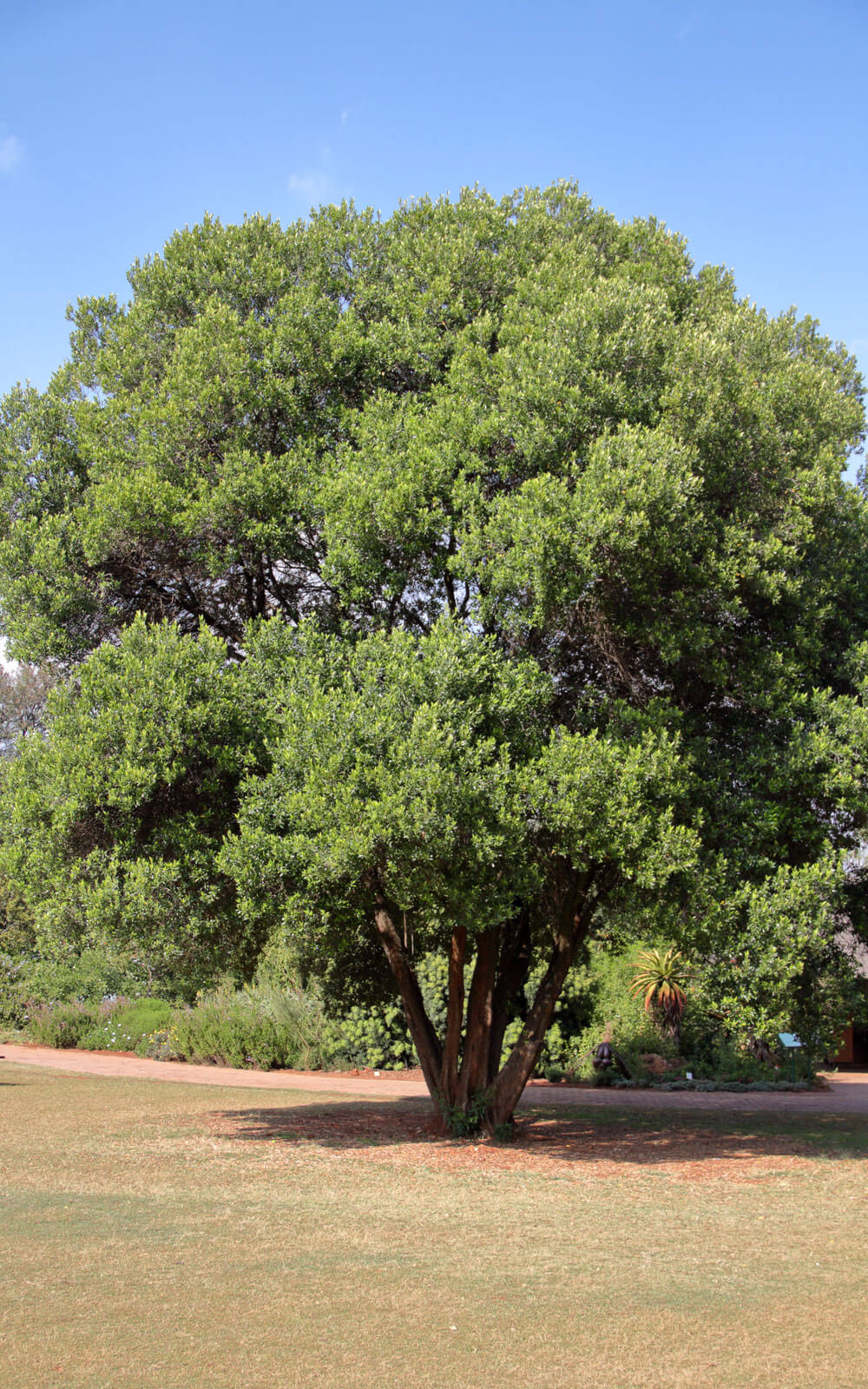
Where Wild Olives are given space, they form neat medium-sized trees and are suitable for sunny, dry spots in gardens.
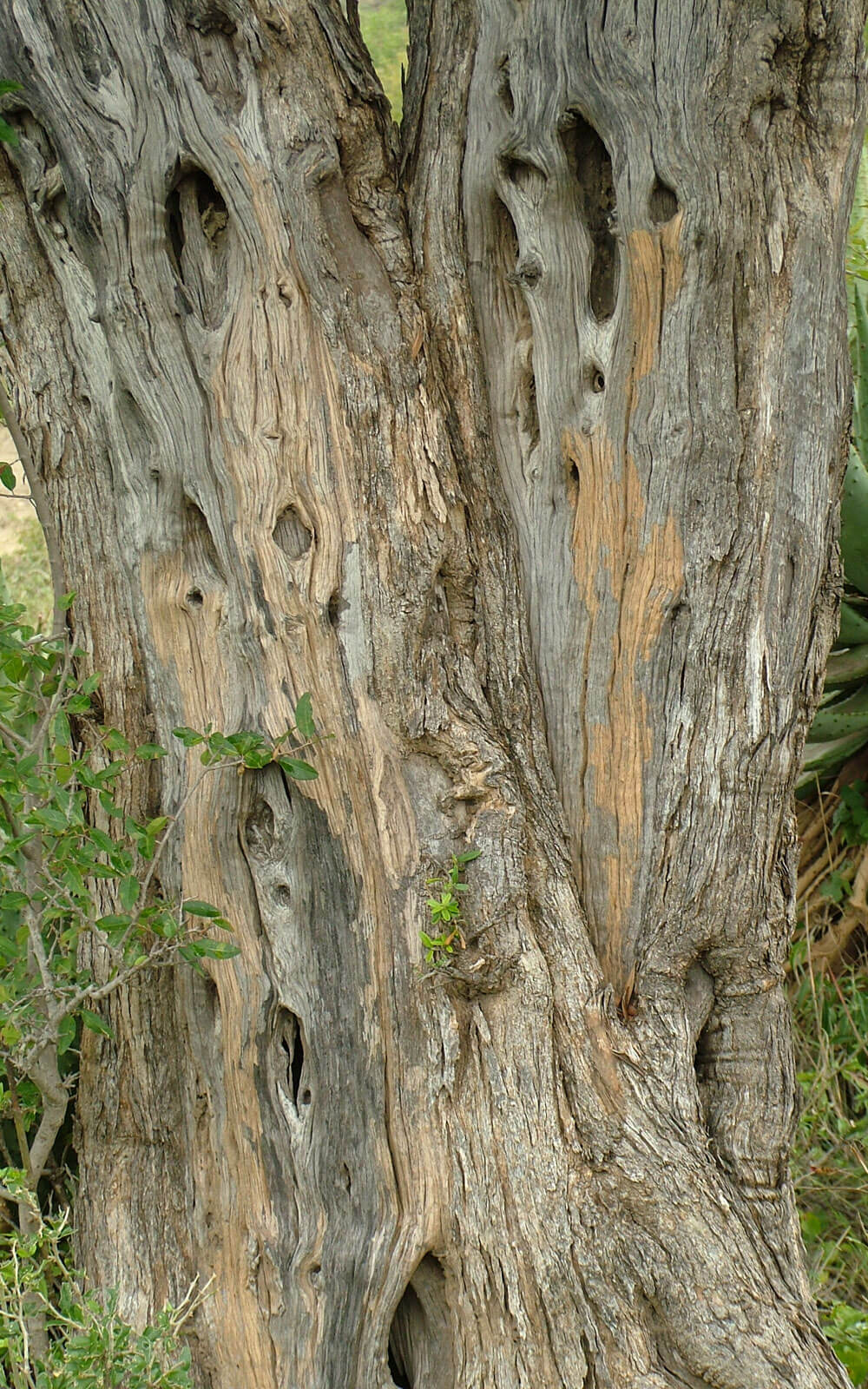
The beautiful gnarled bark of a Wild Olive at Darkest Africa in the Tugela River valley.
One reliable way to recognise an olive—and several other members of the Oleaceae—is by its young twigs, which are square in cross-section, pale and dotted with conspicuous lenticels (pores for gas exchange). The leaves are long and narrow, dark shiny green above and silvery, grey or golden below due to minute scales which reduce water loss. They are arranged in opposite pairs and each pair is arranged at right angles to the next—a pattern known as decussate. Unlike the Red Ivory, the side veins are obscure and the leaf margin is rolled under. Another tip to identify olives and related plants is to break a leaf across its width—the torn surfaces have uneven, ragged edges.
The small white to cream, scented flowers are produced in sprays during spring and summer and are highly attractive to bees. Fruits ripen to purple-black in autumn and early winter and look exactly like little olives.
Fruit straight from the tree is extremely bitter and not recommended, although people, birds and animals do eat them—usually when very ripe. The bitterness comes from oleuropein which is removed during curing to produce culinary olives.
Leaves are used in several regions to help lower blood pressure. In South Africa various plant parts are used traditionally to treat headaches and respiratory and renal ailments, among other things.
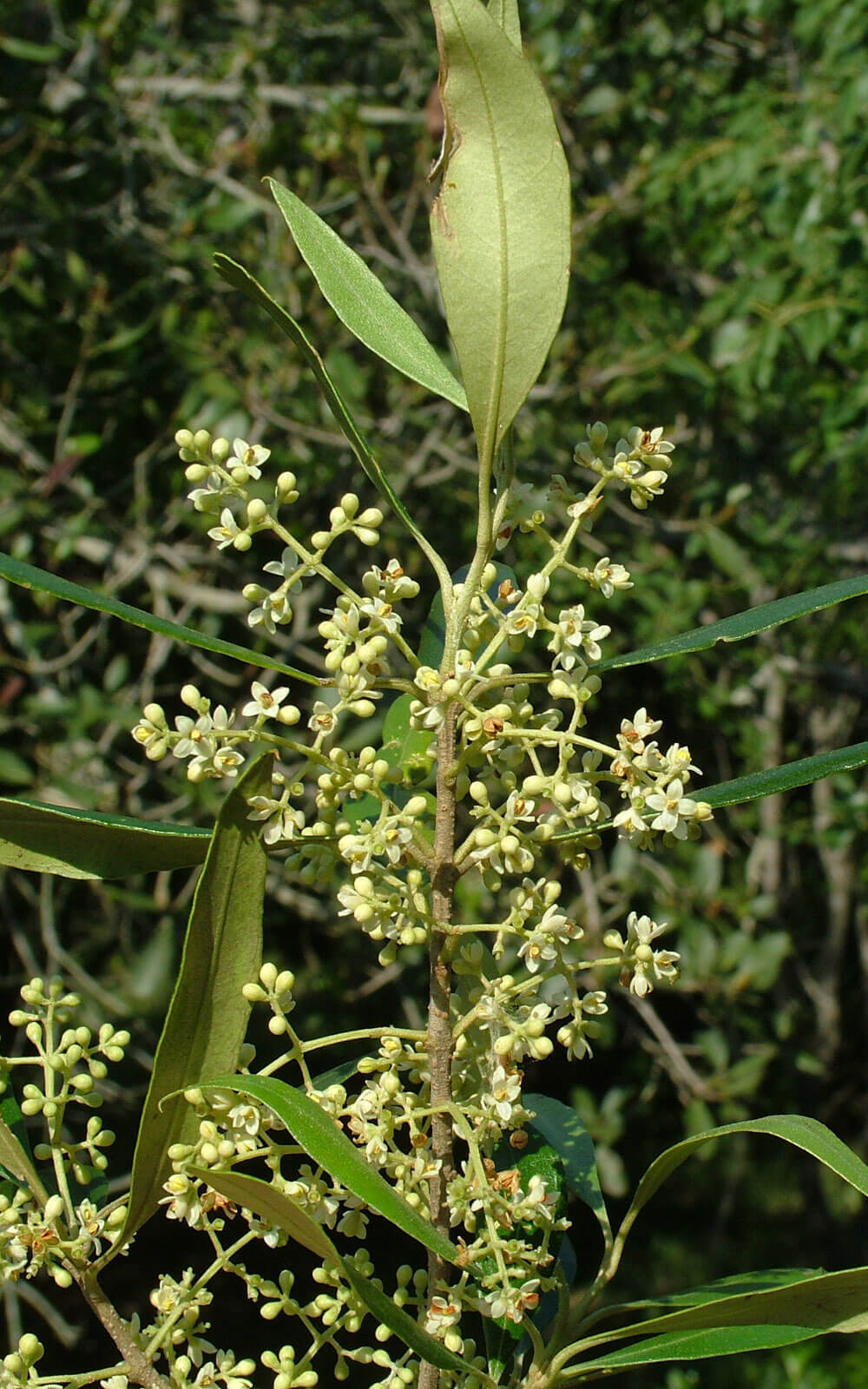
Flowers are small, white to cream and sweetly scented.
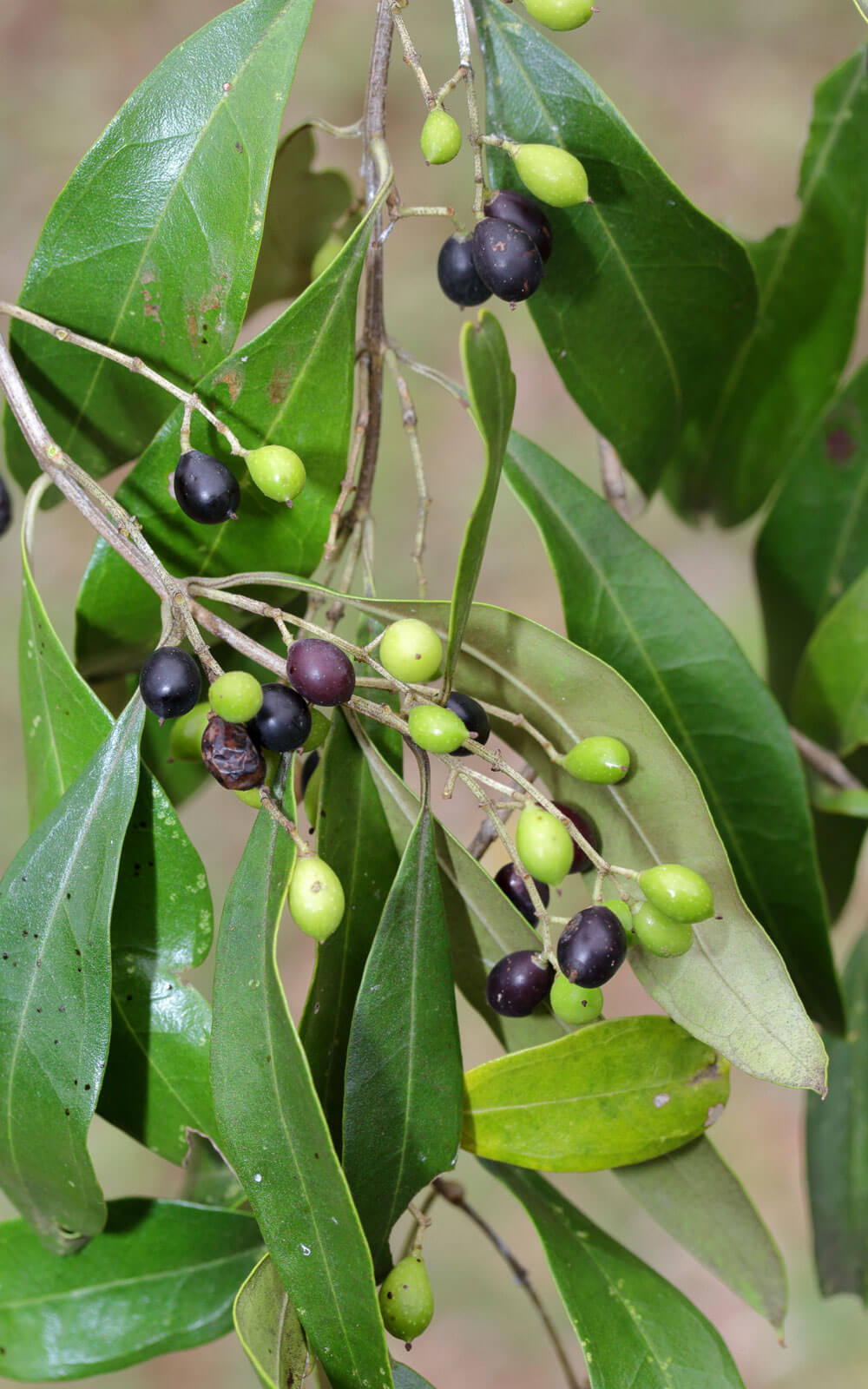
Fruit look like small culinary olives, but they can be very bitter.
The wood of Wild Olives is beautiful, hard and heavy. The sapwood is yellowish brown, while the heartwood ranges from yellowish to reddish brown with darker streaks. Unfortunately, large pieces are seldom available. The timber is used for furniture, ornaments, sticks, fence posts and a long-lasting firewood.
Cultivated olives have become serious environmental weeds in parts of southeastern Australia. They are difficult to kill and may require repeated herbicide treatments.
I don’t think Wild Olives occur naturally in the Krantzkloof Nature Reserve, but they can be found nearby in valley bushveld in the Inanda Valley. Purists living near the Reserve might prefer to grow Olea capensis subsp. enervis (Rock Ironwood).
Wild Olives are tough trees, tolerant of both drought and frost. Trees readily resprout, even after serious damage. They can live for several hundred years, and in some cases even 1000–2000 years. They make excellent pot plants or bonsais, and their cut foliage lasts well in a vase. Epiphytic orchids grow happily on their bark.
Plants can be grown from fresh, cleaned seed or from cuttings dipped in rooting hormone. Growth rates depend on local conditions.
Acknowledgements
Thank you to Professor Adrian Koopman for sharing possible derivations of the Zulu names. In this case, the names probably simply refer to the trees.
References
Boon, R. [R.G.C.] (2010) Pooley’s trees of eastern South Africa. A complete guide. Flora and Fauna Publications Trust, Durban, 626 pp.
Dyer, S., James, B. & James, D. (2016) Guide to the properties of southern African wood. Briza Publications, Pretoria, South Africa.
Esterhuyse, N., Von Breitenbach, J. & Söhnge, H. (2001) Remarkable trees of South Africa. Briza Publications, Pretoria, South Africa.
Glen, H. (2004) Sappi what’s in a name. The meanings of the botanical names of trees. Jacana Media (Pty) Ltd, Johannesburg, 80 pp.
iNaturalist available at https://www.inaturalist.org/home
PlantZAfrica.com
https://pza.sanbi.org/berchemia-zeyheri
https://pza.sanbi.org/olea-europaea-subsp-africana
Plants of the World Online (POWO) available at https://powo.science.kew.org/
Van Wyk, B-E. & Gericke, G. (2000) People’s plants. A guide to useful plants of southern Africa. Briza Publications, Pretoria, South Africa.
Van Wyk, B. & Van Wyk, P. (2013) Field guide to the trees of southern Africa, 2nd edn fully revised. Struik Nature, Cape Town, 732 pp.
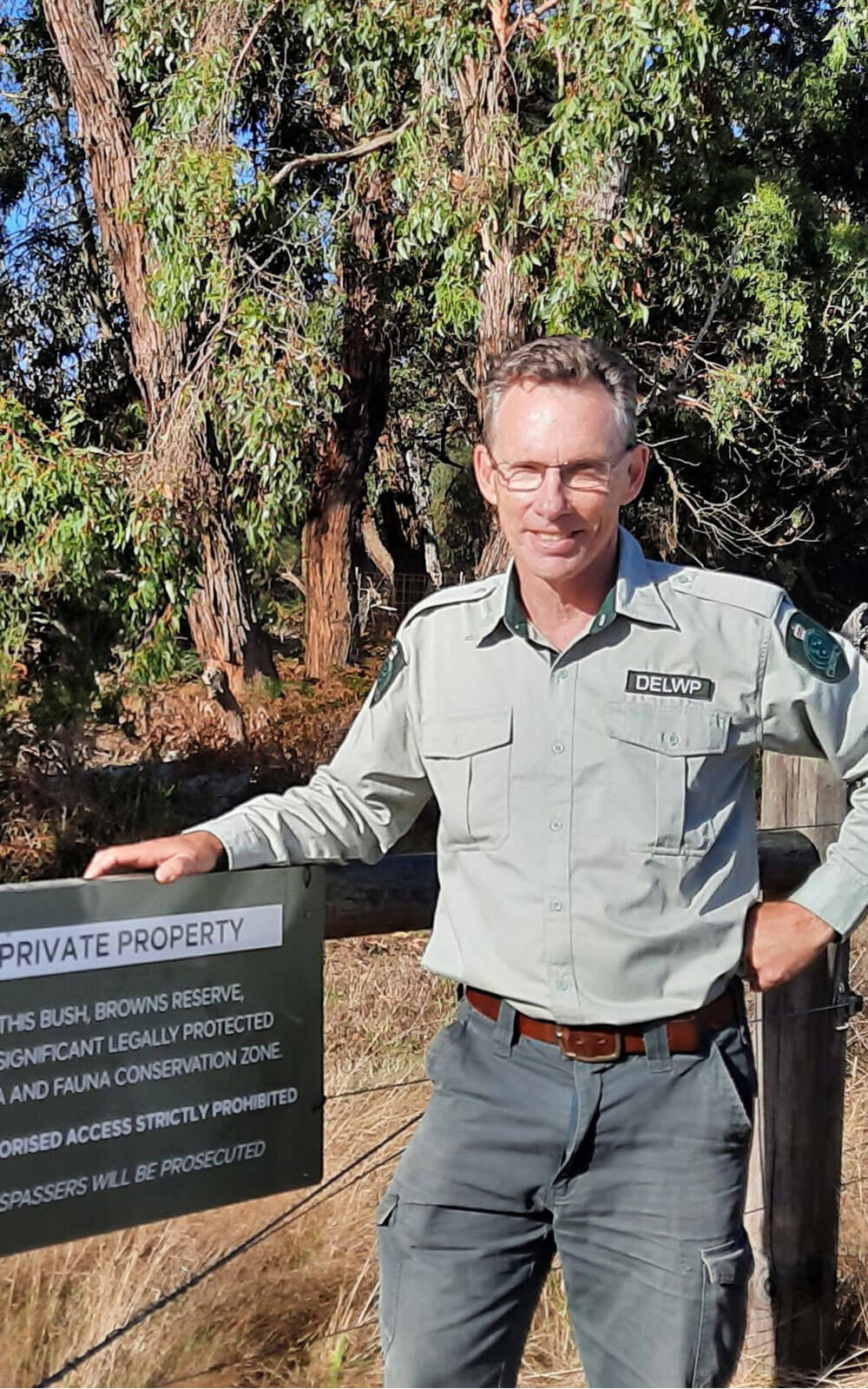
About the author
Richard Boon is well-known not only for his outstanding book Trees of Eastern South Africa – A Complete Guide but also for his environmental work at WESSA in the 90’s and later as part of the Environmental Planning and Climate Protection Department at eThekwini where he headed up the Biodiversity Planning Branch until end 2018. Richard is a practical botanist with over 25 years of field experience. He also enjoys photographing plants and other natural subjects. This article was written for The Leopard’s Echo from his new home in Melbourne, Australia. He currently works for the Victorian state government on native vegetation offset management. The role includes travelling statewide to visit new places and meet landowners. Work involves lots of learning and is much more field-based which has been a nice change. In his spare time, he learns the local ecology, flora and fauna.